


Chromatic Enclosures for Jazz: Stop Playing Straight Bebop Lines
- Darren Lloyd

- Jan 24
- 3 min read
Updated: Jan 25
If your jazz lines are starting to sound a bit straight, predictable, or “scale-y,” chromatic enclosures for jazz are one of the fastest ways to add real jazz language to your playing.
In this short post, I’ll show you how to use chromatic enclosures over a simple ii–V–I in C major, starting with the most important thing of all: target notes.
Get a jazz trumpet solo on 'On green Dolphin street' (can you spot the chromatic enclosures?
The Vehicle: ii–V–I in C Major
We’ll use this progression:
Dm7 → G7 → Cmaj7
Instead of thinking in long bebop lines, we’ll focus on landing clearly on strong chord tones and decorating them with chromatic movement.
Step 1: Target the root on Beat 1 (Ascending)
Start simple.
For each chord, aim for the root on beat 1, moving upward through the progression:
Dm7 → D
G7 → G
Cmaj7 → C

At this stage, don’t worry about being fancy. This alone already gives your solo clarity
because the listener can hear the harmony moving.
If your lines don’t sound clear, it’s often because the target notes aren’t clear.
Step 2: Enclose the Target Note
Now we make it sound like jazz.
To enclose a note, approach it as such below!
There are other ways but for now, let's not get overwhelmed!

Step 3: Target the 3rd on Beat 3
Once beat 1 feels solid, add another strong anchor point.
Now aim for the 3rd of each chord on beat 3:
Dm7 → F
G7 → B
Cmaj7 → E
Again, keep it simple at first:
Target the note cleanly
Then add chromatic enclosures leading into it
This creates a line that:
Clearly outlines the harmony
Swings naturally
Sounds intentional rather than random

Step 4: Enclose the (3rd) Target Note
Now we make it sound like jazz.
To enclose a note, approach it from as such
Again, there are other ways but for now, let's not get overwhelmed!
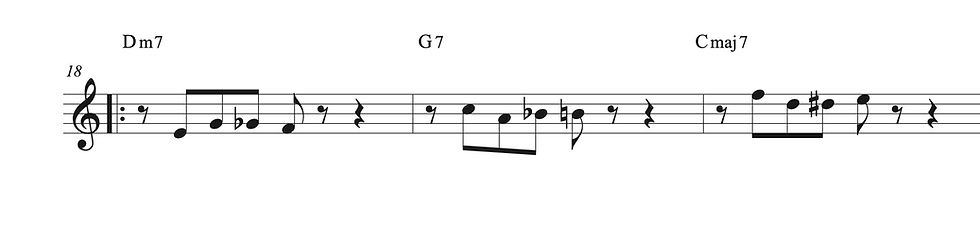
Why This Works So Well in chromatic enclosures jazz
Chromatic enclosures work because they:
Create tension and release
Emphasize strong chord tones
Break you out of straight scale patterns
Make even simple lines sound musical
You don’t need faster fingers — you need better note placement.
Step 5: Put together chromatic enclosures jazz
Now we make it sound like jazz.

Take It Further
If you want to hear chromatic enclosures used in real musical context, check out my jazz trumpet solos and etudes, where these ideas are applied over full standards.
Some of them are available as free downloads and come with backing tracks, so you can practice this language immediately.
👉 Grab a free jazz trumpet lesson below and start applying chromatic enclosures today.
In the lesson I have a whole chorus of 'Happy birthday' using chromatic enclosures as well as a host of other bebop elements!
From my monthly jazz membership at Buy Me A Coffee
Get a jazz trumpet solo on 'On green Dolphin street' (can you spot the chromatic enclosures?
Check out the solo here -
ere is a video I created a while back on chromatic enclosures


Comments